The Becauze take
The reason this matters
The best first-frost setup depends less on choosing a single “best” product than on matching the protection method to the number of plants, available space, and whether the gardener expects to reuse it.
At a glance
What to know first
- Choose row-cover fabric when several plants need protection together.
- Consider individual cloches when only a few plants need separate coverage.
- Relocating container plants can reduce equipment and setup work when a suitable destination is available.
- A larger bed may require both a cover and separate anchors.
- Verify dimensions, ventilation, included accessories, and intended use before buying.
- The Gtongoko staples are an anchoring accessory, not a frost cover.
Featured products
Shop the products mentioned


Prices, sellers and availability can change. Each link opens the corresponding product at the retailer shown on the card.
Explore the category
Browse the relevant Amazon categories
Category rankings, selection, prices and availability can change on Amazon.
Decision guide
Which first-frost approach fits?
| Approach | Best starting use | Setup time | Airflow question | Portability and reuse | Where to check |
|---|---|---|---|---|---|
| Fabric row cover | Several plants in a row or bed | Moderate; placement and securing are required | Check the specific fabric and installation method | Potentially portable and reusable; verify listing claims | Check on Amazon ↗ |
| Individual clear cloches | A few scattered plants or seedlings | Lower for a few plants; scales with plant count | Confirm whether the design provides adequate ventilation | Easy to move individually; reuse depends on construction | Check on Amazon ↗ |
| Relocate container plants | Movable potted plants | Low equipment setup, but requires a suitable destination | Depends on the new location and plant needs | Highly portable when containers are movable | Check on Amazon ↗ |
| Cover plus landscape staples | Larger bed or exposed covering | Highest; requires coverage and edge anchoring | Check the cover’s instructions and installed spacing | Cover and anchors can be stored and reused if the listings support it | Check on Amazon ↗ |
Start with the size and shape of the problem
A first-frost protection kit can mean very different things. A gardener protecting one or two vulnerable plants needs a different setup from someone covering a full raised bed. Before shopping, count the plants that need protection, note whether they are in the ground or containers, and decide whether the cover must stay in place overnight or be moved repeatedly.
The supplied shopping evidence supports looking for two broad categories: “frost protection garden fabric row cover” for broader coverage and “clear garden cloche set” for individual plants. Both are discovery destinations rather than verified product recommendations, so shoppers should compare dimensions, included components, ventilation details, and attachment options on the listing before buying.
Approach 1: Fabric row cover for a group of plants
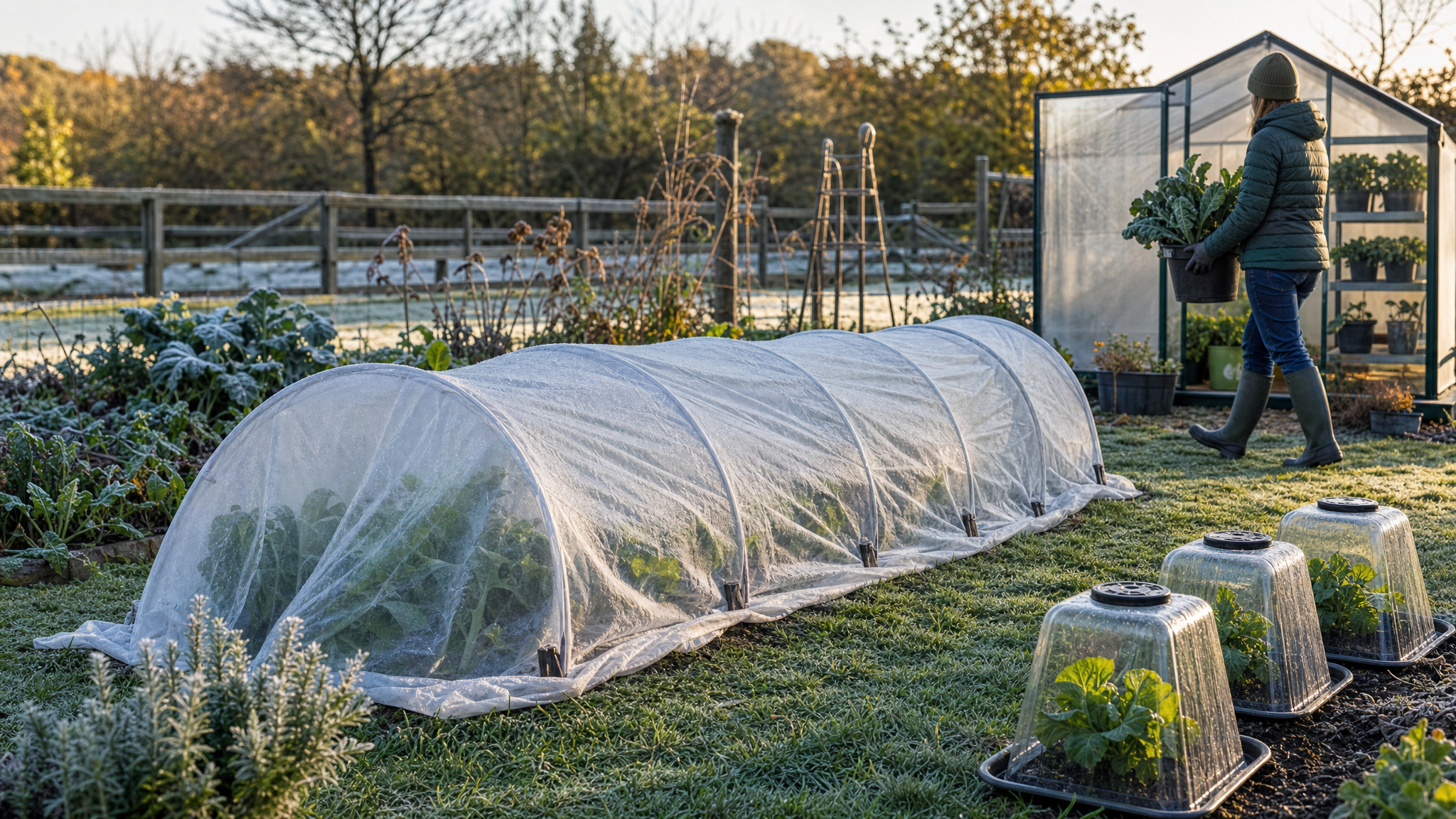
A fabric row-cover approach is the most natural starting point when several plants sit together in a row, raised bed, or compact garden area. It can protect multiple plants with one covering system instead of requiring a separate enclosure for every plant. That makes it a practical candidate for gardeners whose main priority is coverage efficiency.
The tradeoff is setup. A loose sheet needs to be positioned and secured, and the gardener must verify that the selected fabric is large enough for the intended bed. Airflow also depends on how the cover is installed and what the product listing says about its construction; the supplied evidence does not establish a particular fabric’s ventilation performance.
For this approach, look for a row-cover listing that clearly states its dimensions and intended use. Also check whether anchors are included. If they are not, separate landscape staples may be useful for keeping fabric, frost blankets, or ground covers from shifting.
Approach 2: Individual clear cloches
A cloche-style setup is better suited to a few individual plants or seedlings than to a large bed. The main appeal is a more contained cover for each plant, which can simplify placement when plants are scattered or when only a small number are vulnerable. It is also a visually straightforward option for gardeners who want to inspect the covered plant without removing a broad sheet.
The limitations are scale and repeat handling. Protecting many plants may require many individual covers, and the gardener should confirm how each design manages airflow before purchase. The supplied evidence does not verify the dimensions, materials, ventilation, or included quantity of any particular cloche listing.
Use the “clear garden cloche set” search destination to compare options, but treat it as a starting point rather than a recommendation. Confirm that the listing’s coverage area matches the plants being protected and that the product is intended for the relevant outdoor use.
Approach 3: Move container plants instead of covering them
For plants already growing in movable containers, relocation can avoid the need to install a cover over each plant. This approach has no fabric or anchor setup, and it can be highly portable by definition. It may suit a gardener protecting only a few container plants who has a suitable sheltered location available.
Its usefulness depends on the plants actually being movable and on having somewhere appropriate to put them. It does not solve the problem for plants rooted in the ground or for a large bed. Because the supplied evidence does not describe a specific shelter, temperature range, or indoor-care requirement, shoppers should not assume that any particular location is suitable without checking the plant’s needs.
This strategy is best viewed as a way to reduce equipment rather than as a product recommendation. It can be combined with a cover-based method for plants that cannot be relocated.
Approach 4: Build a larger-bed setup from cover plus anchors
A larger bed may need more than the cover itself. The practical strategy is to choose a broad frost-protection material, then add a way to keep its edges from moving. This is the most expandable approach in the guide, but it also requires the most attention to coverage, attachment, and access to the plants.
One verified accessory is the Gtongoko 28 Pack Landscape Staples 6 Inch, Galvanized Garden Stakes. The Amazon listing describes 6-inch galvanized steel staples with pointed ends for securing garden netting, frost blankets, ground covers, and related outdoor materials. The captured price is $5.97, and the listing was marked in stock when the evidence was collected. No rating, review count, or recent-purchase figure was supplied.
The staples are an anchoring accessory, not a complete frost-protection system. Before buying, confirm that the selected cover has enough edge area for secure placement and that the soil can accept the stakes. The listing describes the staples as reusable, but that is a manufacturer or listing claim rather than independent testing.
How the four approaches compare
Use the table as a screening tool, not as a promise of performance. Exact airflow, coverage, durability, and installation details depend on the product selected, and those details were not supplied for the two shopping destinations. The comparison focuses on the decision role of each approach.
For more general options, readers can browse the Amazon “Patio, Lawn & Garden” category. It is a broad discovery page, not evidence that a particular frost-protection product is available or suitable.
Explore more options on Amazon
To explore beyond the featured picks, browse Patio, Lawn & Garden and Pools, Hot Tubs & Supplies on Amazon. These categories let you compare the wider selection and narrow your options by the features, dimensions and budget that matter to you. Category placement is not an endorsement of every listing.
For a more focused starting point, search Amazon for frost protection garden fabric row cover or clear garden cloche set. Refine the results to suit your needs, and check the exact model, seller, current price and return terms before choosing. Search results change and are not individually vetted recommendations.
Before you buy
What to verify
- The supplied evidence does not verify a specific row-cover fabric, cloche, frost blanket, airflow performance, coverage size, or weather rating.
- The four approaches are decision frameworks, not proof that every method will suit every plant or climate.
- The Gtongoko product claims are based on the captured Amazon listing and were not independently tested.
- Price and availability are time-sensitive and should be checked on Amazon before purchase.
- Do not assume the broad Patio, Lawn & Garden category contains a particular product or that a search result is currently in stock.
Reader questions
Frequently asked questions
Individual clear cloches or relocating container plants are the simplest starting points to investigate. Choose based on whether the plants are movable and whether the cloche listing provides suitable dimensions and airflow information.