
The Becauze take
The reason this matters
The best draft-sealing approach depends less on choosing the most substantial-looking product than on matching the seal to the window’s movement, the length of time you can alter the window, and whether you need to preserve operation. Start with diagnosis, use removable materials where reversibility matters, and verify the result before sealing additional areas.
At a glance
What to know first
- Start by locating the draft and identifying whether the window is a sash, casement, or another style before choosing a material.
- Use removable rope caulk when reversibility is important, especially in a rental or during a seasonal test.
- Consider self-stick weatherseal tape for an identified perimeter area that can remain sealed, while keeping moving paths clear.
- Use the clear Duck window insulation kit only after checking dimensions and planning around the window’s required operation.
- Verify the result after installation; the supplied evidence does not establish guaranteed performance for any product.
- Check live price, availability, seller, variant, landlord rules, and product instructions before buying or installing.
Featured products
Shop the products mentioned



Prices, sellers and availability can change. Each link opens the corresponding product at the retailer shown on the card.
Decision guide
Verified options by window-sealing job
| Verified product | Best-supported editorial role | Relevant verified details | Important check before buying | Where to check |
|---|---|---|---|---|
| Frost King V25WA D-Section Rubber Self-Stick Weatherseal Tape, 5/16" W, 1/4" T, 17 ft L, White | Longer-term perimeter-sealing candidate | Self-stick rubber weatherseal tape; 17 ft length; 5/16-inch width; 1/4-inch thickness; observed price $8.39; Amazon listing marked in stock | Confirm the strip can be placed without interfering with sash or casement operation; check live listing details | Check on Amazon ↗ |
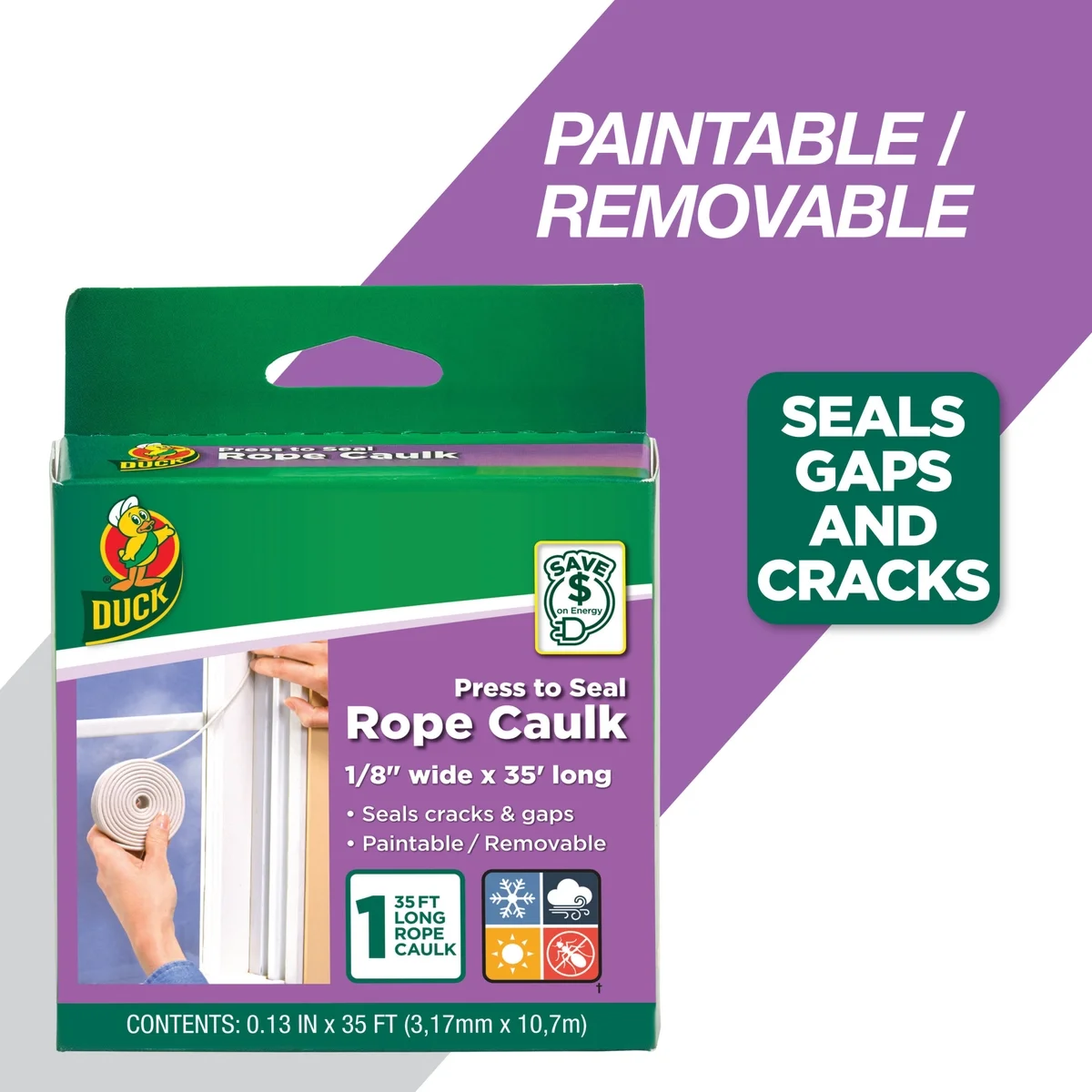
| Duck Brand, 0.125 Inch X 35 Feet White Rubber Rope Caulk For Windows And Doors, Paintable And Removable | Removable or rental-friendly sealing candidate | Rubber rope caulk for windows and doors; listed as paintable and removable; 35 ft length; Walmart availability requires checking | Check current availability, surface compatibility, and whether placement preserves required operation | Check on Walmart ↗ |
| Duck Brand MAX Strength Window Insulation Kit, 84in x 120 in, 2 Pack- Clear | Broader window-area film treatment | Clear window insulation kit; two-pack; listed size 84 by 120 inches; observed price $28.89; Amazon listing marked in stock | Compare dimensions with the actual window and plan installation so the window is not blocked from operating | Check on Amazon ↗ |
| Meat Probe Replacement for Thermopro Thermometer TP04 TP06 etc, 2.5mm Plug | Not a window-sealing option; product-type mismatch to the supplied window workflow | Replacement meat probe; 2.5mm plug; observed price $16.99; Amazon listing marked in stock | Do not buy for window diagnosis; verify compatibility only if replacing a probe for the named thermometer family | Check on Amazon ↗ |
What to do before buying anything
Drafty-window projects are easier to manage when you separate three questions: where air is getting through, whether the window still needs to open, and whether the fix must be removable. The supplied pre-heating-season workflow is built around those decisions: find leaks, choose removable or longer-term seals, install film without blocking operation, and verify the improvement.
A sash window and a casement window do not move in the same way. A sash window has a sliding opening, while a casement has a hinged opening. That difference matters because a seal that is placed across a moving path can interfere with operation. In a rental apartment, reversibility is an additional priority: a temporary material may be more suitable than a longer-term alteration, even if both are intended to reduce drafts.
Before ordering, list the windows by room and note whether each is a sash, a casement, or another style. Mark which windows must remain usable for ventilation or emergency access. Also note whether you are addressing a narrow perimeter gap or a broader glass-and-frame area. Those observations will help determine whether you need weatherseal tape, removable rope caulk, window film, or simply a closer inspection first.
1. Find the leak before choosing the seal
Begin with a room-by-room inspection before applying any product. Look around the window perimeter, the meeting points of moving sections, and the area where the window meets its frame. The purpose is not to seal every visible seam automatically; it is to identify the path that needs attention and avoid placing material where the window must move.
For a sash window, pay particular attention to the places where the sliding sections meet and where the moving window meets the frame. For a casement, inspect the perimeter that contacts the frame when the window is closed. In both cases, open and close the window before applying anything, and record the areas that must remain clear.
A simple inspection checklist can prevent a common mistake: treating a window that is difficult to operate as though it were a permanently closed opening. If the window is intended to open, the final seal should allow that operation when the seal is meant to remain in place. If the window is in a rental and you are not sure what changes are permitted, favor a removable approach and verify the lease or property rules before installation.
2. Choose between perimeter sealing and window film
There are two broad approaches represented by the verified products in this guide. Perimeter materials address gaps around the window or frame. Window film covers the window area as part of an insulation kit. They serve different roles, so they should not be treated as interchangeable.
The Frost King V25WA D-Section Rubber Self-Stick Weatherseal Tape, 5/16" W, 1/4" T, 17 ft L, White is the clearest fit for a longer-term perimeter-sealing task among the supplied products. Its verified product name identifies it as self-stick rubber weatherseal tape and gives its listed dimensions and length. That makes it a candidate when you have identified a perimeter area that needs a fixed strip rather than a material you plan to remove frequently.
The Duck Brand, 0.125 Inch X 35 Feet White Rubber Rope Caulk For Windows And Doors, Paintable And Removable is the removable option in the supplied set. Its product name identifies it as rubber rope caulk for windows and doors and says it is paintable and removable. That profile makes it the most natural candidate for a rental apartment, a seasonal test, or a location where you want to remove the seal later. Availability should be checked at Walmart before relying on it for a project.
The Duck Brand MAX Strength Window Insulation Kit, 84in x 120 in, 2 Pack- Clear is a window-film option rather than a narrow perimeter tape or caulk. Its verified name identifies it as a clear, two-pack window insulation kit with listed dimensions. Consider it when the problem appears to involve the broader window area and you can install the film without preventing the window from operating as intended. The source brief specifically calls for installing film without blocking operation, so that check is part of the job, not an optional finishing step.
3. Match the material to the window type
For sash windows, start by identifying the sliding path. Removable rope caulk can be useful when the goal is to test a seal or preserve reversibility, but it should not be placed where it prevents the sash from moving if the window needs to open. Self-stick weatherseal tape may suit a perimeter location that can remain sealed, provided the tape’s placement does not interfere with the sash’s operation.
For casement windows, inspect the edge that closes against the frame and the perimeter that must meet cleanly when the window is shut. A perimeter weatherseal can be considered where a longer-term strip is appropriate. Removable rope caulk may be better when you need a temporary or reversible approach. Either way, close and reopen the casement carefully after installation rather than assuming the seal is correctly positioned.
For a rental apartment, begin with the least permanent option that addresses the identified path. The supplied rope caulk is explicitly described as removable, so it is the strongest match among these products when reversibility is the deciding factor. Window film may also be considered for a broader window-area problem, but the installation must preserve the intended operation of the window and should be reviewed against rental rules.
These are fit guidelines, not guarantees that any product will solve every window problem. The supplied evidence does not establish which material works best for a particular frame condition, how long an installation will last, or whether a product is approved by a landlord. Those points should be verified before purchase or installation.
4. Measure the project and check the listing
Once you know which windows need attention, measure the areas you intend to cover and compare them with the product’s listed dimensions. The Frost King tape is listed at 17 feet long, with a width of 5/16 inch and thickness of 1/4 inch. The Duck rope caulk is listed as 35 feet long and 0.125 inch in size. The Duck window kit is listed for an 84-by-120-inch window area and comes as a two-pack.
Do not assume that a roll, strip, or kit covers every window in the room. Count the windows, estimate the perimeter or area involved, and leave room for the possibility that the first attempt may need repositioning. The source evidence does not provide coverage calculations for a specific home, so the reader must compare the measurements of the actual windows with the product listings.
Prices in the captured product evidence are observed prices rather than guaranteed quotes. The Frost King tape was listed at $8.39, the Duck window insulation kit at $28.89, and the YAOAWE replacement meat probe at $16.99 when the source excerpt was captured. The Walmart rope-caulk listing did not provide a current price and instead said to check availability at Walmart. Check the live listing for price, stock, seller, variant, and delivery details before buying.
5. Install a perimeter seal without trapping the window
Clean preparation and careful placement are central to a perimeter-sealing job, but the supplied evidence does not specify a particular cleaning product, installation temperature, or cure time. Follow the instructions on the selected product and use the inspection notes from the first step to place the material only where it addresses the identified gap.
For self-stick weatherseal tape, plan the route before exposing the adhesive. The verified Frost King name identifies the tape as self-stick, so the placement decision is difficult to reverse once it is applied. Keep the material out of the sash’s sliding path and away from any point that must hinge or close freely on a casement. After placement, operate the window gently and confirm that it still opens and closes as intended.
For rope caulk, use its removable characteristic to your advantage. It can be treated as a seasonal or test-oriented option, especially in a rental. The Duck product name identifies it as paintable and removable, but the supplied facts do not establish how easily it will remove from every surface or whether it will leave residue. Test a small, inconspicuous area when appropriate and check the product instructions before applying it across multiple windows.
If the window no longer operates correctly, stop and reassess the placement rather than forcing it. A seal that prevents required operation has not met the workflow’s stated goal, even if it appears to close a gap.
6. Use film for a broader window-area treatment
Window film is a different type of intervention from perimeter tape or rope caulk. The supplied Duck Brand MAX Strength Window Insulation Kit is identified as a clear two-pack for windows measuring 84 by 120 inches. It may be relevant when the project calls for covering the broader window area rather than filling a narrow perimeter gap.
Before installing film, confirm that the selected window can still be operated as required after installation. The source brief specifically says to install film without blocking operation. That means the installation plan should account for the sash’s sliding movement or the casement’s hinged movement before the film is applied. Do not treat a film kit as permission to permanently close a window that needs to remain functional.
Follow the kit’s own installation directions for preparation, attachment, and finishing. The supplied evidence does not provide enough information to describe a complete technical installation sequence, the tools required, or the expected durability. What can be said safely is that the kit is a clear window-insulation product, is listed as a two-pack, and should be selected only after its dimensions and installation requirements are compared with the actual window.
7. Verify the improvement instead of sealing blindly
After the first installation, repeat the inspection that led you to the product choice. Check whether the suspected draft area feels different, whether the window still operates correctly, and whether the material remains in the intended position. The brief calls for verifying the improvement, so the project should end with a check rather than with the assumption that more material is always better.
Verification also helps distinguish a local perimeter problem from a broader window-area problem. If a perimeter seal addresses one location but the room still feels drafty, document what remains uncertain before adding film or another layer. The supplied facts do not establish a guaranteed level of improvement for any of these products, so use measured language and avoid treating a single installation as proof that every window has the same issue.
If a seal creates a new problem—such as preventing the window from opening, closing, or operating as intended—remove or reposition the material according to the product instructions. For a rental, retain any removable material and avoid escalating to a more permanent approach without checking the property’s rules.
Which verified product fits which job?
The following comparison keeps each item’s role narrow and evidence-based. It does not rank products by performance because the supplied evidence includes no testing, ratings, customer sentiment, or comparative results. The meat-probe listing is included because it appeared in the captured product set, but it is not a window-sealing product and should not be used as a substitute for the thermometer referenced in the source query. Its presence illustrates why readers should check the exact product type before purchasing.
A replacement probe may be relevant only if a reader already owns a compatible ThermoPro thermometer and needs that specific replacement part. It does not provide the infrared thermometer function suggested by the source query, and the captured facts do not confirm compatibility with any particular reader’s device.
Before you buy
What to verify
- No coupon, discount, expiration date, or time-limited promotion was supplied; this is a how-to guide, not a deal alert.
- No product testing, performance measurements, customer ratings, review counts, or guaranteed draft-reduction results were supplied.
- The source does not establish coverage for a particular home, installation durability, residue behavior, landlord approval, or compatibility with every window material.
- The Walmart rope-caulk listing did not provide a current price and instructed readers to check availability.
- The meat-probe product does not match the window-sealing task or the infrared-thermometer source query; it should not be presented as a draft-detection tool.
- Readers should follow each product’s current instructions and verify live price, availability, seller, variant, dimensions, compatibility, and rental restrictions before purchase or installation.
Reader questions
Frequently asked questions
Among the supplied products, the Duck Brand, 0.125 Inch X 35 Feet White Rubber Rope Caulk For Windows And Doors, Paintable And Removable is the clearest rental-oriented candidate because its verified product name identifies it as removable. Check the lease or property rules first, confirm surface compatibility, and keep the material away from any path that must remain operable. The evidence does not establish how easily it removes from every surface.